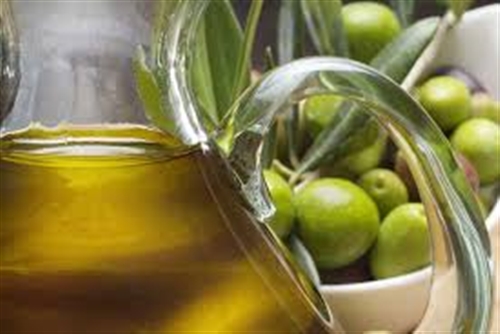
The olive oil produced in the hills of Romagna
is of superior quality and has renowned organolectic qualities,
yet it still remains mostly unknown and little appreciated.
Today, olive oil is the number one dressing used in Mediterranean cuisine, but
in the olden days it was considered a “luxury” in Romagna which was
more familiar with the cold, hunger and hard work, especially in the hilly inland
areas and the mountains; traditionally, the use (or nowadays we would say the
abuse) of fat and lard in our popular Romagnol specialities was commonplace and
they were so calorific that we could almost call them a “second winter
coat”.
Extra virgin olive oil produced in olive groves on the hills of the Provinces
of Forlì-Cesena and Rimini has distinctive characteristics, with excellent
organolectic qualities and a very low level of acidity: it has recently obtained
the Denominazione di Origine Protetta (D.O.P.) – a recognition of quality.
- “Colline di Romagna”. The area between Roncofreddo, Montiano, Longiano
and Borghi is well-known for its consistently high quality production; other
excellent areas are also the high lands of Modigliana and Forlì, Forlimpopoli,
Bertinoro, Cesena and Savignano
“Colline di Romagna”
Extra virgin olive oil
In Romagna oil production is on the increase. Up to a while ago,
it was not financially viable, but now that the European Community
has decided to award D.O.P. (a recognition of quality) to our
oil, producers will be able to make a good living. So it is not
a coincidence that every year ten to twelve thousand olive trees
are planted, adding to the ones already existing, some of which
are centuries old.
The land in question is home to an important olive growing heritage,
from a financial and rural point of view, even if the olive trees
are concentrated in some particular areas. Most of the trees
are to be found in the low and mid-hills. The mid-hills make
up the innermost and central part of the land which is distinctive
for its significant differences in height, generally varying
between 200 and 400 metres above sea level. The low hills make
up the most common example of land in the area and are distinguished
by all the features to be found below 200 m.
In this area, olive tree growing, together with wine producing,
is the only arboreal cultivation possible and employs farm workers
who are laid off at certain times of the year.
According to statistics provided by the Emilia-Romagna region,
the total surface area given to olive trees is around 1400 hectares
with about 300,000 trees, 70% of which are in the province of
Rimini, 20% in Forlì-Cesena and 10% in Ravenna.
The olives are milled in 25 local oil presses, spread out over
the area as follows: 20 in the province of Rimini and 5 in the
province of Forlì-Cesena.