Piadina
The
Piada or
Pida or
Piedar, as it is called in the local dialect, is the symbol of Romagna food culture, synonymous with conviviality, food simple but tasty.
The etymology of the word Piadina is uncertain: some scholars connect it to the greek "plakous" which means focaccia; while the "text" which is derived from the Latin cotta head, shard.
An easy to prepare food, to cook at any time even in times of misery as they could also be produced with a little fine flour.
It is a flat bread whose main ingredients are flour, water and salt which over time and with increasing disposable income, you went to add lard or olive oil, baking soda, milk, peel lemon, so that every family follow a particular recipe.
The same dough is going to prepare even the
Crescioni or
Cassoni, the crescent-shaped turnovers stuffed, the
Fried Piadina, the
Sweet Piadina and Tortelli alla Lastra.
In January 1920 an illustrated magazine La Pie was founded at Forlì and published by Aldo Spallicci. The Editorial claimed:
“Nothing can describe Romagna better than our bread (...).So it is a symbol which cries devotion to our land”. This statement, together with the name given to the monthly magazine, shows the ability piadina has to identify and unite Romagna under one symbol. Identitying piadina with Romagna predates the foundation of La Pie and is to be attributed to the famous poet Giovanni Pascoli who called it
“the national bread of the people of Romagna”.
Piadina romagnola, or piada romagnola, pie romagnola, pjida romagnola, pièda romagnola, pji
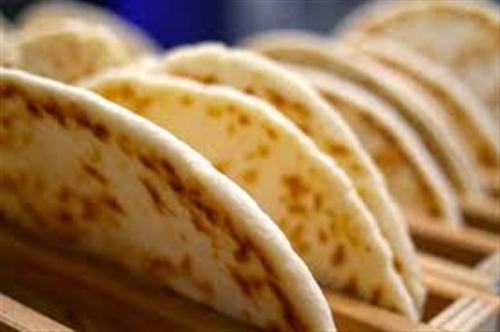
romagnola, pida romagnola, in Romagna means a flat mixture of wheat flour, water and salt and, in some places, other ingredients, too. The classical piadina romagnola is rolled out thinly with a rolling pin, placed on a low-rimmed terracotta plate (whose shape is rather primitive) and cooked on burning embers. You get a large circular disk, speckled brown by the heat, which is crumbly, tender with a very delicate flavour, and is best eaten with good local cured meat, fresh, soft cheese, wild herbs and a generous glass of Sangiovese di Romagna.
The basic piadina is made with: 1 kg of flour, 20 g of raising agent, 180-200 g of lard, a pinch of salt and half a litre of milk. Piadina traditionally made at home in the countryside has the following ingredients: flour, lard, sodium bicarbonate and sugar. The simplest is made, instead, without lard and with water instead of milk.
Piadina experts know that it is virtually impossible and perhaps even wrong to establish the definitive recipe. There are too many local variations which vary from family to family to establish the exact formula. The same thing applies for more elaborate dishes: everyone claims their recipe to be the real one.
It may have many different aspects, but there are some set limits.
The height, for instance. It cannot be flatter than the piadina made at Piccione or higher than that made at Forlì.
As far as the size is concerned, it should be as big as the plate of "Montetiffi" it was traditionally cooked on, you should not skimp on the filling and it must be well cooked.
So, it is a real riddle for connoisseurs and traditionalists. Luckily three things are always the same: water, flour and salt. The rest is a variation on the theme: type and quality of fat used, oil, sugar, raising agent and milk. Some people even use honey.
It is quite unusual that something which is not really even a real dish is such a food puzzle; but, despite this, it can boast ancestors and relations all over the world.
It belongs to the same family as Jews’ unleavened bread. On the other hand, raising agent was used in cooking for the first time in Ancient Egypt.
Objectively, the piadina can be likened to carasao bread or thin “carta musica”, Arabic bread, unleavened rolls found in Turkey, Maghreb and Eritrea. You can find traces of it in India and even in Latin America: if we use corn instead of wheat flour, we get the equivalent of “tortillas".
Piadina can be served with a variety of food since it is so versatile. Perhaps it is best enjoyed with food which can melt like cheese and cured meat. But beware: do not eat it with too salty cured meat, like ham from Tuscany.
There are just two exceptions to this rule: with wild green herbs and potatoes, typical of the Tuscan-Romagnol Apennines – but that’s it.
Pascoli confirms it in one of his poems:
"Simple, holy bread of the poor (...) which is eaten with country herbs...".
You cannot get away from tomato and mozzarella fillings, even though they have strictly been stolen from pizza, and Nutella, which it is almost a crime to eat with piadina.
It is all right to experiment, but there is a limit between the dishes.
In the meantime, our traditional “bread” is enjoying a financial boom with the commerical success of precooked, packed piadinas.
It is a sign of the times. It is not made at home anymore, there is no time and people don’t know how to. This has brought about the emergence of “piadinerie” or – more recently – industrially produced packets. It is following the same road pasta went down.
For many scholars, the change in people’s tastes is due to the fact that the terracotta plate is not longer used. But the cast-iron or iron plates are actually excellent substitutes. There is a secret though: piadina must be eaten no more than three minutes after it has been cooked or else it will lose its unequalled fragrance.