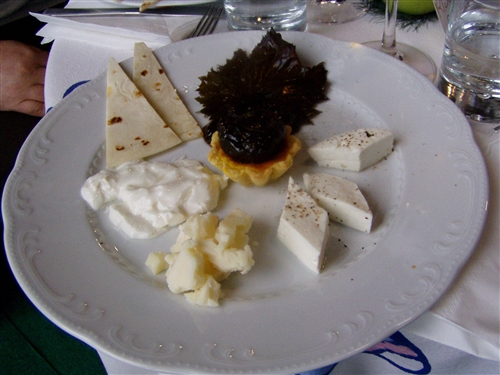
“Squaquarone” is
one of the typical cheeses of the area and is mostly eaten with “piadina
romagnola” (a kind of unleavened bread). Like “cassatella”,
it is a variation on the earlier “ravviggiolo”. The
main ingredient is full fat cow’s milk which is curdled.
The difference between this soft cheese and “raviggiolo” is
in the ageing and salting processes. The shape is indefinite
(which is where it gets its name from: “acqua” meaning
water and describing its soft, liquid consistency) and weighs
between 1 and 3 kg. It is soft and tender, without a rind and
tastes of slightly acidulous milk. It is produced all year round
but is eaten fresh within three days at the most. (continue)
RAVIGGIOLO
The
first mention of this cheese was in 1500 when some “raviggioli” were
presented to Pope Leon X as a gift.
It is a characteristic fresh, white cheese, obtained from curdling
raw cow’s milk. It is round, placed on fern leaves, or
more rarely on cabbage leaves, and is 3 or 4 cm high. The cheese
is soft and tender and tastes delicate and sweet. It can only
be kept for a couple of days (maximum 3), so has always been
produced between October and March. The area of its production
is limited to the upper Apennines.
CASSATELLA
Also
a typical fresh, soft cheese produced in Romagna, it is different
from the two above because of its preparation and especially
its maturing which can last as long as 30 days. It is cylindrical
and weighs between 0.2 and 2 kg, and has a white or straw yellow
rind which you can just about see. The cheese is white and soft
and tastes of milk enzymes. The name cassatella points to its
household origin because it was traditionally made at home by
farmers. Many scholars claim it to be a descendant of “raviggiolo”.
PECORINO OR CACIOTTA ROMAGNOLA
The
rearing of sheep for the production of “cacio” can
be traced back to the first century in Romagna. In 1st Century
Rome, Pliny the Elder’s historical documents have references
to a pecorino cheese “sarsinate”, coming from the
Sarsina Valley in the Cesena area. Through the centuries, it
has become a traditional product of the upper-mid hills of Romagna,
concentrated in the valleys of the Provinces of Forli’-
Cesena and Rimini. It has a regular round shape and is traditionally
produced by cheesemakers who use only milk from their own animals.
Pecorino comes from curdling raw sheep’s milk and is found
in shapes weighing from about 0.8 to 1 kg or even more and can
be eaten semi-mature (after 20-30 days) or mature (after over
60 days). The length of maturing determines the appearance of
the cheese, as well as its taste: it is softer and sweeter when
semi-mature and sharp and tangy when mature. The “pecorino/caciotta
romagnola” is used to produce “formaggio di fossa” (cheese
which is left to mature in underground pits).
Pecorino Ubriacone Stagionato in Vinaccia (Drunk Pecorino Seasoned
in Wine Barrels) is a variation on the product described above.
The traditional ageing of the cheese takes place in wine barrels
which have just been emptied of black grapes after the grape
harvest and wine production, and gives the pecorino a sharp taste,
but a sweet wine smell, and it is particularly soft inside even
in cheeses left to mature for more than a year. It is mainly
produced between September and November.
FORMAGGIO DI FOSSA
At
Sogliano al Rubicone, leaving cheese to mature in underground
pits between summer and late autumn is an old custom, dating
back to around 1400; the humidity, the temperature and the lack
of oxygen in the pits where the cheeses are stored, cause the
cheese to ferment again wonderfully in just a couple of months.
When the cheese it taken out of the pits, it is an irregular
cylindrical shape with an average weight of 0.8 - 1 kg. The rind
and inside cannot be told from each other and are compact and
crumbly; the smell and taste are characteristic and strong. The
cheeseis supplied by cheesemakers scattered about the province
of Forli’-Cesena mainly from sheeps’ milk but also
from a mixture of cows’ and sheeps’ milk from their
own herds, obtaining excellent pecorino and caciotta cheeses.
The pits are opened on 1st August until the end of September
for the cheeses to be put in, which means that it comes from
the highest quality products from the spring-summer production.
The maturing of the cheese inside the characteristic pits dug
into the tufo dating back to the Middle Ages takes about three
months and gives the cheese that recognizable and unmistakable
smell and taste, thanks to the fermentation which takes place
in these particular conditions. “Fossa” cheese contains
a high percentage of fat and predigested proteins which make
it one of the most digestible cheeses available.
The pits at Sogliano al Rubicone are then opened at the end of
November during the celebrated “Formaggio di Fossa” festival.